 Central General Practice
 Repulse Bay
 Clearwater Bay
 BodyWorX Clinic
 Central Specialist Clinic
 MindWorX Clinic
 Family Clinic
 OT&P Annerley Midwives Clinic
 WellWorX Clinic

Why Earlier Detection Changes Everything
Alzheimer's disease (AD) is a slow, relentless thief. By the time a person notices memory slipping, the brain has already been under siege for decades. Amyloid plaques and neurofibrillary tau tangles accumulate silently, long before a single symptom emerges. For clinicians and patients alike, this timeline has always been a bitter irony: the disease is most treatable before it becomes detectable.
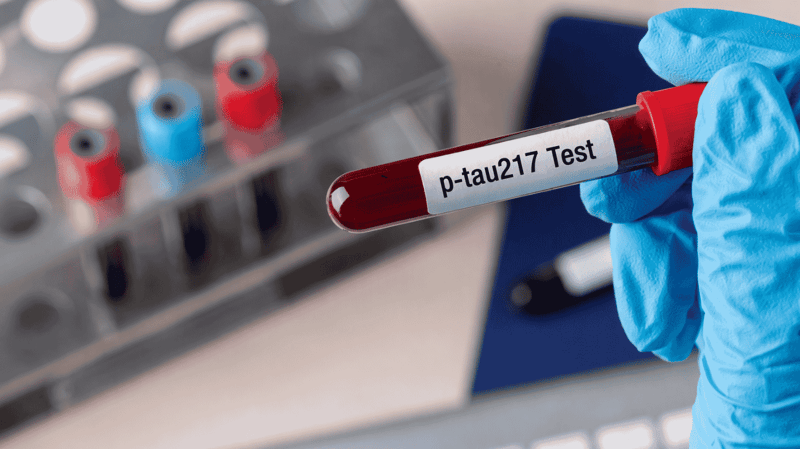
That calculus is now changing. A new generation of blood-based biomarkers, particularly phosphorylated tau (p-tau) proteins, is reshaping how we think about early Alzheimer's diagnosis. Specifically, phosphorylated tau at threonine 217 (p-tau217) has emerged as the most promising of these markers, with the potential to bring accurate, accessible, minimally invasive testing to clinics worldwide.
The Biology: What Is P-Tau and Why Does It Matter?
Tau is a structural protein found in neurons. In Alzheimer's disease, tau loses its functional shape, and collects into the neurofibrillary tangles (NFTs) that are a hallmark of AD pathology.1
Fragments of this abnormal protein leak from the brain into the bloodstream, where they can be measured. Among the various p-tau isoforms studied, p-tau217 has shown the most promise for testing a meta-analysis established p-tau217 as the premier blood-based biomarker for AD across disease stages and ethnic groups.2
How Early Can It Detect Disease?
One of the most striking findings in this field is just how far ahead of symptoms p-tau217 can signal disease. In people who carry genetic mutations causing early-onset AD, levels of p-tau217 correlated with those who later developed the disease up to 20 years before symptoms were seen.3
In cognitively healthy older adults, the predictive power is equally remarkable:4
-
Those with very high p-tau217 had an estimated 78% risk of developing cognitive impairment over 10 years
-
Even those with slightly elevated p-tau217 (just above average) carried a 45% risk over 10 years
-
The blood test provided prognostic information beyond what brain scans and genetic testing (including APOE genotyping) could offer alone
Furthermore, plasma p-tau217 levels increase over 8.5% annually during preclinical stages, enabling longitudinal monitoring before any clinical signs appear.5
Diagnostic Accuracy: How Good Is the Test?
The short answer: remarkably good. Recent studies and regulatory approvals reflect a technology that has genuinely come of age.
Head-to-Head vs. Traditional Methods
-
A large study of 1,213 patients presented at the Alzheimer's Association International Conference (AAIC) 2024 showed that the p-tau217-based PrecivityAD2 blood test significantly outperformed both primary care doctors and specialists using traditional diagnostic methods.6
-
Blood p-tau217 measurements were approximately 90% accurate at distinguishing people who later had Alzheimer's damage found in their brains at autopsy, and approximately 90% accurate at distinguishing those who later developed dementia symptoms — performance comparable to PET imaging and CSF testing.3
-
Plasma p-tau217 achieved an AUC of 0.941 (94.1%) in clinical validation of 524 participants presenting with cognitive impairment.7
-
Recent real-world memory clinic data show plasma p-tau217 has sensitivity of 0.88 and specificity of 0.84 for AD, and meaningfully led to diagnostic revisions in 30.2% of cases, improving overall diagnostic confidence from 65.1% to 79.4%.8
Regulatory Approval and Clinical Availability
The field has rapidly moved from research to clinical practice:
-
The FDA has cleared plasma p-tau217 blood tests, with the first such test using only one biomarker (p-tau217) to aid in ruling in an AD diagnosis.9
-
P-tau217 is also now used to monitor patients on anti-amyloid therapies, supporting treatment decisions in early symptomatic AD.10
Guideline Recommendations: Where Do We Stand?
In July 2025, the Alzheimer's Association published its first-ever Clinical Practice Guideline (CPG) on the use of blood-based biomarkers in specialised care settings.11 Key recommendations include:
-
Blood-based biomarker (BBM) tests with ≥90% sensitivity and ≥75% specificity can be used as a triaging test for amyloid pathology in patients with objective cognitive impairment presenting to specialised care settings.
-
BBM tests with ≥90% sensitivity and specificity can serve as a substitute for amyloid PET or CSF testing in those settings.
The American Academy of Family Physicians (AAFP) has also recognised BBM testing as an emerging adjunct to diagnostic evaluation in primary care, emphasising that shared decision-making is essential for patients and caregivers to understand the benefits, limitations, and implications of testing.12
Clinical Applications Beyond Diagnosis
The uses of p-tau217 extend well beyond confirming a diagnosis:
Clinical Trial Enrichment
P-tau217 blood tests could provide a simple and accurate tool for identifying cognitively unimpaired patients who likely have amyloid-beta plaques, enabling enrolment in prevention trials at the earliest disease stages.6
Monitoring Treatment Response
For patients on disease-modifying anti-amyloid therapies, serial p-tau217 measurements offer a minimally invasive way to track biological response over time.10
Differential Diagnosis
Beyond AD, plasma p-tau217 significantly impacts the classification of synucleinopathies (e.g., Parkinson's disease dementia, dementia with Lewy bodies) and other cognitive disorders, helping differentiate AD from overlapping neurodegenerative syndromes.8
Risk Stratification and Lifestyle Intervention
There is emerging evidence that patients informed of elevated amyloid or tau biomarkers may be more likely to engage in cognitive training, physical activity, and other lifestyle modifications aimed at preserving brain health.13
Current Limitations and Unanswered Questions
Despite enormous promise, important challenges remain:
-
Assay standardisation: Different cut-offs are reported across centres and platforms, limiting direct comparability of results.14
-
Indeterminate results: In clinical validation studies, approximately 17% of results fall in an indeterminate zone, requiring further testing.7
-
Community screening: While p-tau217 shows high negative predictive value in community settings, its positive predictive value in cognitively unimpaired community-dwelling adults remains low, underscoring that a single biomarker is insufficient for population-level screening.15
-
Diverse population data: Further research is needed in racially and ethnically diverse populations to validate accuracy and thresholds across groups.3
-
Psychological impact: Disclosure of elevated biomarkers in cognitively asymptomatic individuals carries real psychological risk, requiring careful communication and support frameworks.13
Looking Ahead: A Paradigm Shift in Dementia Care
The trajectory of this field is clear. Alzheimer's disease affects over 60% of the world's 57 million current dementia cases, with prevalence projected to exceed 100 million by 2050.5 Traditional diagnostic tools — lumbar puncture, PET imaging — are invasive, expensive, and inaccessible for most of the world's population. P-tau217 blood testing offers something genuinely transformative: a minimally invasive, scalable, accurate window into the brain, decades before symptoms emerge.
For the Functional Medicine clinician, this is particularly relevant. The long preclinical window that p-tau217 illuminates is precisely where lifestyle, metabolic, and environmental interventions have their greatest potential leverage. Identifying elevated p-tau217 in a cognitively intact 50-year-old creates an opportunity to address metabolic risk, sleep quality, chronic inflammation, insulin resistance, and neurotrophic support — not as a reaction to dementia, but as a proactive, biologically-informed strategy to delay or prevent it.
We are entering an era where the question is no longer "Can we detect Alzheimer's early enough to act?" The answer, increasingly, is yes.

Dr Tim Trodd
- MBBS (London)
- DCH (London)
- DRCOG (UK)
- MRCGP (UK)
- FHKAM (Family Medicine)






































































References
- Lai, R., Li, B. and Bishnoi, R. (2024). ‘P-tau217 as a Reliable Blood-Based Marker of Alzheimer’s Disease.’ Biomedicines, 12(8), p. 1836. Available at: https://doi.org/10.3390/biomedicines12081836.
- Chen, X., Huang, T., Shi, C., Xu, S. and Fan, S. (2026). ‘Diagnostic performance of plasma p-Tau217, p-Tau181, and p-Tau231 across the Alzheimer’s disease continuum: a network meta-analysis.’ Frontiers in Aging Neuroscience, 18, p. 1834591. Available at: https://doi.org/10.3389/fnagi.2026.1834591.
- National Institute on Aging. (n.d.). ‘Blood tests show promise for early Alzheimer’s diagnosis.’ Alzheimers.gov. Available at: https://www.alzheimers.gov/news/blood-tests-show-promise-early-alzheimers-diagnosis [Accessed: 3 November 2026].
- Alzheimer’s Association. (2026). ‘Blood Test Predicts Alzheimer’s Risk a Decade Early.’ AAIC news release. Available at: https://aaic.alz.org/releases-2026/blood-test-p-tau217-predicts-alzheimers-risk.asp [Accessed: 3 November 2026].
- Fu, W. and Ho, P.C.L. (2026). ‘Blood-based biomarkers for Alzheimer’s disease.’ Ageing Research Reviews, 117, p. 103058. Available at: https://doi.org/10.1016/j.arr.2026.103058.
- Alzheimer’s Association. (2024). ‘Alzheimer’s Blood Tests Could Improve Diagnosis.’ AAIC news release. Available at: https://aaic.alz.org/releases-2024/blood-tests-alzheimers-biomarkers.asp [Accessed: 3 November 2026].
- ARUP Consult. (2025). ‘Phospho-Tau 217, Plasma: Test Fact Sheet.’ ARUP Laboratories. Available at: https://arupconsult.com/ati/phospho-tau-217-plasma [Accessed: 3 November 2026].
- Huang, Y.Y., Li, L.L., Yao, R.X. et al. (2026). ‘Plasma p-Tau217 improves diagnostic accuracy and clinician confidence in cognitive disorder classification.’ The Innovation, 7(6), p. 101272. Available at: https://doi.org/10.1016/j.xinn.2026.101272.
- Anderer, S. (2026). ‘FDA Approves 2 New Alzheimer Disease Blood Tests.’ JAMA, 336(14), p. 1197. Available at: https://doi.org/10.1001/jama.2026.14721.
- Pontecorvo, M.J., Lu, M., Burnham, S.C. et al. (2022). ‘Association of Donanemab Treatment With Exploratory Plasma Biomarkers in Early Symptomatic Alzheimer Disease.’ JAMA Neurology, 79(12), pp. 1250 to 1259. Available at: https://doi.org/10.1001/jamaneurol.2022.3392.
- Palmqvist, S., Whitson, H.E., Allen, L.A. et al. (2025). ‘Alzheimer’s Association Clinical Practice Guideline on the use of blood-based biomarkers in the diagnostic workup of suspected Alzheimer’s disease within specialized care settings.’ Alzheimer’s & Dementia, 21(7), e70535. Available at: https://doi.org/10.1002/alz.70535.
- Willis, D.R., Summanwar, D. and Brosch, J.R. (2025). ‘Blood Biomarkers and Early Detection of Alzheimer’s Disease and Related Dementias.’ FPM, 32(3), pp. 17 to 20. Available at: https://www.aafp.org/fpm/2025/0500/alzheimers-detection [Accessed: 3 November 2026].
- Price, M.Z. and Small, G.W. (2025). ‘Benefits and Risks of New Tests for Alzheimer’s Disease.’ The Journal of Clinical Psychiatry, 86(2). Available at: https://doi.org/10.4088/JCP.25com15837.
- Martí-Navia, A., Álvarez-Sánchez, L., Ferré-González, L. et al. (2025). ‘Clinical validation of new alzheimer disease diagnosis tools based on plasma p-Tau217.’ Scientific Reports, 16, p. 1472. Available at: https://doi.org/10.1038/s41598-025-31613-x.
- Grande, G., Valletta, M., Rizzuto, D. et al. (2025). ‘Blood-based biomarkers of Alzheimer’s disease and incident dementia in the community.’ Nature Medicine, 31(6), pp. 2027 to 2035. Available at: https://doi.org/10.1038/s41591-025-03605-x.