 Central General Practice
 Repulse Bay
 Clearwater Bay
 BodyWorX Clinic
 Central Specialist Clinic
 MindWorX Clinic
 Family Clinic
 OT&P Annerley Midwives Clinic
 WellWorX Clinic
.png?width=120&name=Tim%20Trodd%20(1).png)
When most people think about testosterone, they think about the testes, the Leydig cells that produce it, the pituitary signals that drive it, and the blood levels that measure it. What almost nobody thinks about is the gut.
Yet emerging science is making one thing increasingly clear: the health of your gut microbiome may be one of the most important, and most overlooked, determinants of how much testosterone your body actually produces.
The Gut-Testis Axis
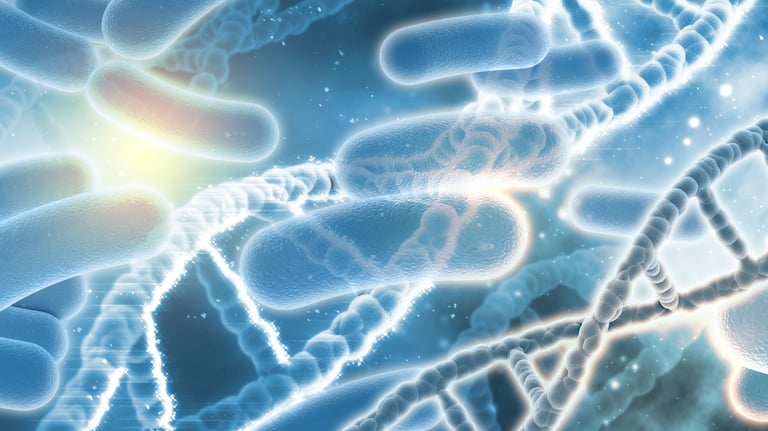
The gut microbiome does not simply digest food. It functions as a de facto endocrine organ, producing, metabolising, and regulating hormones throughout the body, including sex hormones.[1] The relationship between gut bacteria and testosterone is now sufficiently established that researchers have coined a specific term for it: the gut microbiota-testis axis, or "androbactome."[2]
A 2025 systematic review published in PeerJ found a significant positive correlation between gut microbiome composition and testosterone levels in men, proposing multiple biological mechanisms through which gut bacteria influence androgen production.[3] Separately, research published in the Journal of Neurogastroenterology and Motility demonstrated that men and women with higher testosterone or oestradiol levels consistently show a more diverse gut microbiome — confirming that the relationship runs in both directions.[4]
Put simply: a healthy, diverse gut microbiome supports robust testosterone production. A disrupted microbiome, dysbiosis, suppresses it.
How Does the Gut Actually Affect Testosterone?
The mechanisms are multiple and interconnected:
1. The Inflammation Pathway
When the gut microbiome becomes disordered, harmful bacteria produce lipopolysaccharide (LPS), a toxic compound that leaks through a damaged gut wall into the bloodstream, triggering systemic inflammation. This LPS-driven inflammation directly impairs the Leydig cells responsible for testosterone synthesis in the testes.[3] Studies show that a compromised gut barrier, "leaky gut", is among the most potent suppressors of testicular function.
2. Androgen Metabolism
The gut microbiome plays a direct role in processing androgens. Research has shown that dihydrotestosterone (DHT), the most potent androgen, is present in faecal matter at concentrations 70 times higher than in blood, and that gut bacteria are responsible for the crucial process of "deglucuronidation", converting bound, inactive testosterone metabolites back into their free, active form.[4] When this process is disrupted by dysbiosis, the body loses a meaningful portion of its circulating testosterone.
3. The HPG Axis
The gut communicates directly with the hypothalamic-pituitary-gonadal (HPG) axis, the hormonal command chain that orchestrates testosterone production. Gut metabolites, including short-chain fatty acids (SCFAs) produced by beneficial bacteria fermenting fibre, act as signalling molecules that influence pituitary output of LH and FSH, the hormones that tell the testes to produce testosterone.[4][5]
4. The Antibiotic Effect on Testosterone
Animal studies have shown that antibiotic exposure inhibits steroidogenesis (testosterone production) by impairing Leydig cell mitochondrial function, the very cellular machinery that manufactures testosterone.[4] Mice exposed to doxycycline showed reduced microbiome diversity and changes in composition.[4] This is a biological reminder that antibiotics, while essential when needed, carry a hormonal cost that is rarely discussed.
5. Metabolic Health as the Mediator
Gut dysbiosis drives insulin resistance and metabolic dysfunction and insulin resistance is one of the most powerful suppressors of testosterone.[6] A Frontiers in Endocrinology study found that diabetic men with testosterone deficiency showed more severe gut dysbiosis than diabetic men with normal testosterone, with specific pathogenic bacteria directly correlated with both lower testosterone and poorer metabolic markers.[6] The gut, metabolism, and testosterone form a triangle when one fails, all three suffer.
What About Specific Bacteria?
Research is beginning to identify which bacteria matter most. Ruminococcus has shown a particularly strong positive correlation with testosterone levels.[7] Strains from the phylum Firmicutes have been independently associated with blood testosterone levels in men.[8] And Lactobacillus reuteri, a strain present in the human gut since antiquity, has produced some of the most striking results in animal studies, with supplementation producing measurable increases in testosterone and testicular size.[9]
Can Probiotics Improve Testosterone and Sperm Quality?
The clinical evidence here is growing and increasingly compelling, particularly for sperm quality.
A 2026 systematic review and meta-analysis confirmed that probiotics can significantly improve sperm parameters in men with idiopathic infertility.[10] In one double-blind RCT, infertile men who received a six-month course of a multi-strain probiotic (Lactobacillus, Bifidobacterium, and Streptococcus thermophilus) saw sperm concentration double on average, alongside improvements in motility and reductions in abnormal forms.[2] Crucially, the same group also showed modest but significant rises in testosterone and LH, and five men in the treatment group fathered children compared to none in the placebo group.[11]
A separate RCT in 50 infertile men using a 7-strain probiotic formula for 10 weeks reported a rise in sperm count of approximately 15 million/mL and significant improvement in progressive motility alongside measurable reductions in oxidative stress markers in the semen itself.[2]
For testosterone specifically in healthy men, the human RCT evidence is still maturing, and it would be premature to claim that probiotics reliably raise testosterone in men with no identified dysbiosis.[3] But what the evidence does clearly support is that gut dysbiosis suppresses testosterone through inflammatory and metabolic pathways, and that restoring microbial balance removes those suppressors.[3]
The Practical Implication
If you are working to optimise your testosterone levels or improve sperm quality, treating the gut cannot be an afterthought. The same gut-healing strategies that apply to overall health:
-
A diverse, fibre-rich diet
-
Avoidance of unnecessary antibiotics
-
Targeted probiotic supplementation
-
Reduction of sugar, ultra-processed foods, and gut-disrupting chemicals, are also, in the truest sense, hormonal interventions
The gut is not just where you digest food. It is where a significant portion of your hormonal identity is shaped.
Putting It All Together
The decline in male testosterone and sperm counts is real, it is global, and it is accelerating. It is not simply an ageing phenomenon. It is a biological response to the world we have created, one saturated with endocrine-disrupting chemicals, poor nutrition, chronic stress, and sedentary behaviour.
The good news is that many of these causes are modifiable. The functional medicine approach, test thoroughly, identify root causes, reduce toxic load, correct deficiencies, optimise lifestyle, and use targeted pharmaceuticals where needed, gives every man the best possible chance of reclaiming his hormonal health.
The body wants to be well. Sometimes it just needs us to get out of its way.

.png?width=200&name=Tim%20Trodd%20(1).png)
Dr Tim Trodd
- MBBS (London)
- DCH (London)
- DRCOG (UK)
- MRCGP (UK)
- FHKAM (Family Medicine)


-4.png?width=768&name=%5BMKT%5DWebsite%20Blog%20Photo%20(23)-4.png)
-3.png?width=768&name=%5BMKT%5DWebsite%20Blog%20Photo%20(19)-3.png)

-2.png?width=768&name=%5BMKT%5DWebsite%20Blog%20Photo%20(15)-2.png)
-2.png?width=768&name=%5BMKT%5DWebsite%20Blog%20Photo%20(14)-2.png)
-4.png?width=768&name=%5BMKT%5DWebsite%20Blog%20Photo%20(13)-4.png)
-1.png?width=768&name=%5BMKT%5DWebsite%20Blog%20Photo%20(12)-1.png)
-3.png?width=768&name=%5BMKT%5DWebsite%20Blog%20Photo%20(11)-3.png)
![[Part 3] The Hidden Hormonal Control Centre: Your Gut and Testosterone Featured image](https://www.otandp.com/hs-fs/hubfs/%5BMKT%5DWebsite%20Blog%20Photo%20%288%29-2.png?width=768&name=%5BMKT%5DWebsite%20Blog%20Photo%20%288%29-2.png)
![[Part 2] Do You Have Low Testosterone? Tests & Treatment Explained Featured image](https://www.otandp.com/hs-fs/hubfs/%5BMKT%5DWebsite%20Blog%20Photo%20(7)-4.png?width=768&name=%5BMKT%5DWebsite%20Blog%20Photo%20(7)-4.png)
![[Part 1] The Silent Decline in Men's Testosterone and Sperm Counts Featured image](https://www.otandp.com/hs-fs/hubfs/%5BMKT%5DWebsite%20Blog%20Photo%20(6)-2.png?width=768&name=%5BMKT%5DWebsite%20Blog%20Photo%20(6)-2.png)










































References
- Pires, L., Gonzalez-Paramás, A.M., Heleno, S.A. and Calhelha, R.C. (2024). 'Gut microbiota as an endocrine organ: unveiling its role in human physiology and health'. Applied Sciences, 14(20), 9383. Available at: https://doi.org/10.3390/app14209383 [Accessed 17 June 2026].
- Kaltsas, A., Giannakodimos, I., Markou, E., Stavropoulos, M., Deligiannis, D., Kratiras, Z. and Chrisofos, M. (2025). 'The androbactome and the gut microbiota-testis axis: a narrative review of emerging insights into male fertility'. International Journal of Molecular Sciences, 26(13), 6211. Available at: https://doi.org/10.3390/ijms26136211 [Accessed 17 June 2026].
- Pakpahan, C., Laurus, G., Hartanto, M.C., Singh, R., Saharan, A., Darmadi, D., Rezano, A. and Wasian, G. (2025). 'Potential relationship of the gut microbiome with testosterone level in men: a systematic review'. PeerJ, 13, e19289. Available at: https://doi.org/10.7717/peerj.19289 [Accessed 17 June 2026].
- Yoon, K. and Kim, N. (2021). 'Roles of sex hormones and gender in the gut microbiota'. Journal of Neurogastroenterology and Motility, 27(3), pp. 314–325. Available at: https://doi.org/10.5056/jnm20208 [Accessed 17 June 2026].
- Organski, A.C., Rajwa, B., Reddivari, A., Jorgensen, J.S. and Cross, T.L. (2025). 'Gut microbiome-driven regulation of sex hormone homeostasis: a potential neuroendocrine connection'. Gut Microbes, 17(1), 2476562. Available at: https://doi.org/10.1080/19490976.2025.2476562 [Accessed 17 June 2026].
- Liu, S., Cao, R., Liu, L., Lv, Y., Qi, X., Yuan, Z., Fan, X., Yu, C. and Guan, Q. (2022). 'Correlation between gut microbiota and testosterone in male patients with type 2 diabetes mellitus'. Frontiers in Endocrinology, 13, 836485. Available at: https://doi.org/10.3389/fendo.2022.836485 [Accessed 17 June 2026].
- Matsushita, M., Fujita, K., Motooka, D., Hatano, K., Hata, J., Nishimoto, M., Banno, E., Takezawa, K., Fukuhara, S., Kiuchi, H., Pan, Y., Takao, T., Tsujimura, A., Yachida, S., Nakamura, S., Obara, W., Uemura, H. and Nonomura, N. (2022). 'Firmicutes in gut microbiota correlate with blood testosterone levels in elderly men'. The World Journal of Men's Health, 40(3), pp. 517–525. Available at: https://doi.org/10.5534/wjmh.210190 [Accessed 17 June 2026].
- Poutahidis, T., Springer, A., Levkovich, T., Qi, P., Varian, B.J., Lakritz, J.R., Ibrahim, Y.M., Chatzigiagkos, A., Alm, E.J. and Erdman, S.E. (2014). 'Probiotic microbes sustain youthful serum testosterone levels and testicular size in aging mice'. PLoS ONE, 9(1), e84877. Available at: https://doi.org/10.1371/journal.pone.0084877 [Accessed 17 June 2026].
- Hengky, A., Putranata, H., Telium, H.D., Prihadi, J.C., Putra, P.A. and Alvianto, S. (2026). 'Probiotic supplementation improved sperm parameters in idiopathic infertility male: a systematic review and meta-analysis'. Urología Colombiana, 35(1), pp. 39–48. Available at: https://doi.org/10.24875/RUC.25000029 [Accessed 17 June 2026].
- Magill, R.G. and MacDonald, S.M. (2023). 'Male infertility and the human microbiome'. Frontiers in Reproductive Health, 5, 1166201. Available at: https://doi.org/10.3389/frph.2023.1166201 [Accessed 17 June 2026].


-1.png?length=500&name=%5BMKT%5DWebsite%20Blog%20Photo%20(40)-1.png)