 Central General Practice
 Repulse Bay
 Clearwater Bay
 BodyWorX Clinic
 Central Specialist Clinic
 MindWorX Clinic
 Family Clinic
 OT&P Annerley Midwives Clinic
 WellWorX Clinic
.png?width=120&name=Tim%20Trodd%20(1).png)
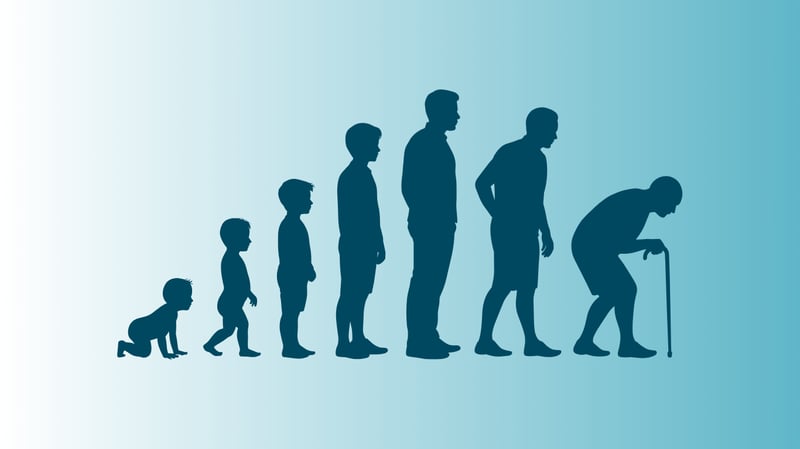
Shakespeare’s Seven Ages of Man and the Reality of Modern Ageing
In Shakespeare’s poem The Seven Ages of Man, the final stage of life is described as being “sans teeth, sans eyes, sans taste, sans everything”. Fortunately, ageing in the 21st century looks very different from how it did 500 years ago. Advances in modern medicine, preventative healthcare, and dentistry mean that many people can now maintain their teeth, eyesight, and overall health well into later life. Dental implants, cataract surgery, and proactive medical care have transformed what ageing can look like today.
Ageing, Life Expectancy, and Physical Capability
The seven ages of man are often illustrated using stereotypes that depict a steady physical decline from childhood to old age. The final image is typically an elderly man, stooped over and dependent on a walking stick. In Shakespeare’s time, average life expectancy was less than 50 years. Today, however, many individuals can maintain strength, mobility, and physical capability well into their eighties and beyond.
Poor posture and a flexed spine are not inevitable consequences of ageing. In many cases, they reflect preventable physical decline rather than biological necessity. Reliance on a walking stick is often caused by reduced balance, leg weakness, and a shortened gait. Maintaining muscle strength, balance, and posture throughout life is usually straightforward; restoring them once they are lost is far more challenging.
Healthy Ageing, Mobility, and Preventing Physical Decline
Healthy ageing is increasingly understood as the preservation of function rather than the absence of disease. Maintaining mobility, balance, and posture plays a critical role in extending healthspan, the number of years lived in good physical and mental health.
Preventative strategies, including regular movement, strength training, and posture awareness, can significantly reduce the risk of frailty, falls, and loss of independence later in life. Evidence consistently shows that physical decline is not an inevitable part of ageing, but something that can often be delayed or avoided with the right approach.
Longevity, Vitality, and How Appearance Influences Wellbeing
Ageing stereotypes have wider implications beyond physical health. Research has shown that humans subconsciously judge others based on their appearance, posture, and movement. Maintaining vitality, strength, and physical function therefore influences not only how we age, but also how we are perceived by others.
Investing in long-term health and longevity is never too early, or too late. Preserving physical capability and appearance can positively affect confidence, self‑perception, and overall quality of life. In the modern era, longevity is no longer just about living longer, but about maintaining vitality, independence, and function for as many years as possible.


References
- Claudino, J.G., Afonso, J., Sarvestan, J., Lanza, M.B., Pennone, J., Filho, C.A.C. et al. (2021) 'Strength training to prevent falls in older adults: a systematic review with meta-analysis of randomized controlled trials', Journal of Clinical Medicine, 10(14), 3184. Available at: https://pmc.ncbi.nlm.nih.gov/articles/PMC8304136/
-
Willis, J. and Todorov, A. (2006) 'First impressions: making up your mind after a 100-ms exposure to a face', Psychological Science, 17(7), pp. 592–598. Available at: https://journals.sagepub.com/doi/10.1111/j.1467-9280.2006.01750.x
- World Health Organization (2020a) Healthy ageing and functional ability. Available at: https://www.who.int/news-room/questions-and-answers/item/healthy-ageing-and-functional-ability
- World Health Organization (2020b) WHO guidelines on physical activity and sedentary behaviour. Geneva: World Health Organization. Available at: https://www.who.int/publications/i/item/9789240015128