 Central General Practice
 Repulse Bay
 Clearwater Bay
 BodyWorX Clinic
 Central Specialist Clinic
 MindWorX Clinic
 Family Clinic
 OT&P Annerley Midwives Clinic
 WellWorX Clinic

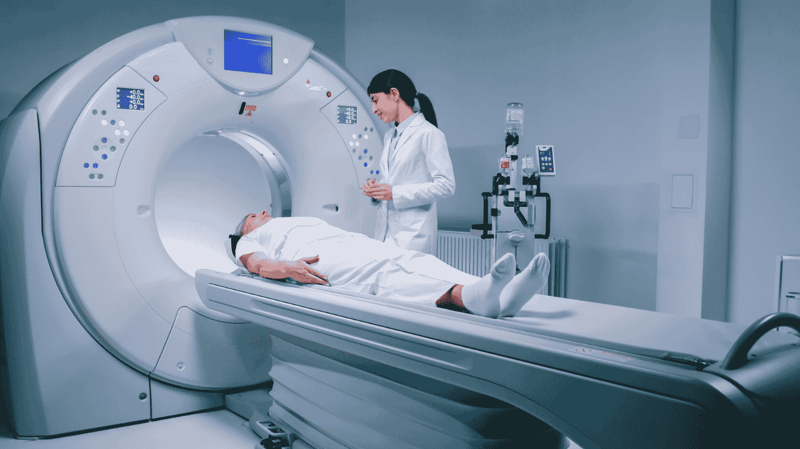
Medical imaging has become an essential tool for diagnosing diseases and monitoring health conditions. Magnetic Resonance Imaging (MRI) is a vital imaging technique, widely used to diagnose soft tissue disorders, tumours, and monitor health.
This article will provide a comprehensive overview of MRI, with a particular focus on its application in cancer diagnosis and disease monitoring. We will also explore the cost differences between public and private healthcare sectors in Hong Kong and address common misconceptions to help you make an informed decision based on your individual needs.
What Is MRI?
MRI is a non-invasive imaging technique that uses powerful magnetic fields and radio waves to generate high-resolution images of the body’s internal structures, providing doctors with essential information to aid in diagnosis. Importantly, MRI does not involve ionising radiation, making it a safe option for many patients.
MRI vs CT: What’s The Difference?
| MRI | CT Scan | |
| Imaging Technology | Magnetic fields & radio waves | X-rays (a form of ionising radiation) |
| Image Quality | Better at contrast resolution – ideal for distinguishing between healthy and cancerous tissues |
Better ay spatial resolution – excellent for defining structural edges |
| Best For | Joints, nerves, brain, soft tissue masses | Bones, kidney stones, blood vessels, lungs, abdominal trauma |
| Scan Duration | Longer (30–50 minutes) | Shorter (under 1 minute) |
| Safety | No ionising radiation | Involves radiation |
How Is MRI Used in Cancer Care?
Cancer Diagnosis
MRI is highly effective in scanning various parts of the body and plays a crucial role in cancer diagnosis. It can detect tumours, determine their size and extent, and help doctors assess the cancer stage. MRI is particularly useful for diagnosing the following cancers:
- Brain tumours
- Primary bone tumours
- Soft tissue sarcomas
- Spinal cord tumours
- Pelvic organ tumours: such as prostate cancer* (the 3rd most common cause of male cancer-related death in Hong Kong), bladder cancer, corpus uteri cancer* (the 4th most common cancer among Hong Kong females), and ovarian cancer* (the 7th most fatal cancer among Hong Kong females).
Disease Monitoring
MRI is also used for monitoring disease progression after cancer treatment, helping doctors evaluate tumour shrinkage and detect signs of recurrence.
How Much Does An MRI Scan Cost?
The cost of an MRI scan in Hong Kong varies depending on the type of healthcare provider, the area being scanned, and whether a contrast agent is required.
MRI Charges in Public Hospitals vs Private Sectors
Public Hospitals: Fees are generally lower. Inpatient MRI for eligible patients is free, while outpatient non-urgent MRI costs HKD $500†.
Private Services referred by Public Hospitals: Approximately HKD $3,000 - $20,000.
Private Healthcare Providers: More expensive, ranging from HKD $4,400 - $35,000.
†Effective from 1 January 2026.
Did you know? In Hong Kong public hospitals (excluding top-priority cases), the median waiting time for routine MRI scans in 2023-2024 was as long as 92 weeks (about 1.5 years!). While public hospital prices are more affordable, long waiting times may not suit those needing urgent scans. Private providers offer shorter waiting times and more flexible scheduling, albeit at a higher cost. Understanding the differences can help you make a more informed choice.
OT&P also provides MRI services – please consult our family doctors to discuss the most suitable examination and costs for you.
Common Misconceptions & FAQs about MRI
1. Is Contrast Administration Always Required for An MRI Scan?
No. Contrast agents are mainly used when clearer images of specific blood vessels or tissues are needed. Not every MRI requires a contrast administration.
2. Are Contrast Agents Harmful?
Gadolinium-based contrast agents are generally considered safe. Allergic reactions are rare, with the risk of a fatal reaction estimated at about 1 in 400,000. In very rare cases, patients with kidney failure may develop nephrogenic systemic fibrosis after receiving gadolinium contrast. If you have any concerns, discuss them with your doctor prior to the scan.
3. Can Breastfeeding Women Receive Contrast Injections?
Yes. Research shows the amount of contrast agent retained in breast milk is extremely low and unlikely to harm your baby. However, breastfeeding women are advised to wait 24 hours after the injection before resuming breastfeeding.
4. Who May Not Be Suitable for An MRI Scan?
MRI may not be suitable for individuals who:
- Have metal implants, devices, or prostheses (e.g. pacemakers, dentures, orthopaedic screws)
- Are currently or were previously a metal worker
- Have a history of injuries involving metallic fragments
- Have Tattoos or permanent eye-lining
- Are currently pregnant or possibly pregnant
- Claustrophobia
- Have history of renal failure, renal disease, or renal surgery
5. Are There Any Side Effects from MRI?
MRI itself uses no radiation and is generally free from side effects. Some patients may experience temporary discomfort during the scan, such as difficulty lying still or noise disturbance. Only around 1% of patients receiving contrast may experience mild symptoms, such as headache, dizziness, nausea, vomiting, or discomfort at the injection site. Fear of enclosed spaces (claustrophobia) may be more of a concern as studies have shown that up to 35% of patients undergoing MRI experience this.
Choose Based on Your Needs
MRI is an advanced and safe imaging technique, especially important in cancer diagnosis. Whether you opt for public or private healthcare, it’s important to choose based on your health condition, budget, and urgency. If you have any concerns, consult your doctor for professional advice to ensure you receive the most appropriate scan and care.

References
- Cancer Online Resource Hub. (n.d). ‘Magnetic Resonance Imaging Examination (MRI).’ Available at: <https://www.cancer.gov.hk/en/cancer_diagnosis/scan_angiography/magnetic_resonance_scan.html> [Accessed 3 June 2025].
- Hospital Authority. (2007). ‘磁力共振檢查安全病人須知 ’ Available at: <https://www.ha.org.hk/haho/ho/conjoint/127415c.pdf> [Accessed 3 June 2025].
- Cleveland Clinic. (2023). ‘CT Scan vs. MRI: How They Work and What They Show’ Available at: <https://health.clevelandclinic.org/ct-scan-vs-mri> [Accessed 3 June 2025].
- MD Anderson Cancer Center. (2023). ‘CT scan vs. MRI: What’s the difference?’ Available at: <https://www.mdanderson.org/cancerwise/ct-scan-vs-mri--what-is-the-difference.h00-159616278.html> [Accessed 3 June 2025].
- Cancer Research UK. (2025). ‘MRI scan.’ Available at: <https://www.cancerresearchuk.org/about-cancer/tests-and-scans/mri-scan> [Accessed 3 June 2025].
- Hospital Authority. (2024). ‘Overview of Hong Kong Cancer Statistics of 2022’ Available at : <https://www3.ha.org.hk/cancereg/pdf/overview/Overview%20of%20HK%20Cancer%20Stat%202022.pdf> [Accessed 3 June 2025].
- Sing Tao Headline. (2025). ‘公立醫院收費懶人包︱一文睇清新收費 街症$150 專科$250 磁力共振檢查$500’ Available at:<https://www.stheadline.com/society/3440923/%E5%85%AC%E7%AB%8B%E9%86%AB%E9%99%A2%E6%94%B6%E8%B2%BB%E6%87%B6%E4%BA%BA%E5%8C%85%E4%B8%80%E6%96%87%E7%9D%87%E6%B8%85%E6%96%B0%E6%94%B6%E8%B2%BB-%E8%A1%97%E7%97%87150-%E5%B0%88%E7%A7%91250-%E7%A3%81%E5%8A%9B%E5%85%B1%E6%8C%AF%E6%AA%A2%E6%9F%A5500> [Accessed 3 June 2025].
- Hospital Authority. (2025). ‘List of Private Services’ Available at: <https://www3.ha.org.hk/fnc/Radiology.aspx?lang=ENG> [Accessed 3 June 2025].
- CUHK Medical Centre. (2025). ‘Radiology Service – MRI.’ Available at: <https://www.cuhkmc.hk/fees-and-charges/radiology-service-mri> [Accessed 3 June 2025].
- The Specialists. (2025). ‘Price Lists of Diagnostic Imaging’ Available at: <https://www.specialists.hk/en/subpage.php?pg=262> [Accessed 3 June 2025].
- Info.gov. (n.d.). ‘附件:放射診斷檢查服務量’. Available at: <https://gia.info.gov.hk/general/202406/26/P2024062600505_462777_1_1719390730008.pdf> [Accessed 3 June 2025].
- NHS. (2022). ‘MRI scan: How it’s performed’ Available at: <https://www.nhs.uk/conditions/mri-scan/what-happens/> [Accessed 3 June 2025].
- The Breastfeeding network. (2025). ‘FactSheet: MRI Scans and Breastfeeding.’ Available at: <https://www.breastfeedingnetwork.org.uk/factsheet/mri/> [Accessed 3 June 2025].
- Brennan, S., et al. (1988). 'Anxiety and Panic During Magnetic Resonance Scans.' The Lancet, 332(8609), p.512.



.png?length=500&name=%5BMKT%5DWebsite%20Blog%20Photo%20(42).png)