 Central General Practice
 Repulse Bay
 Clearwater Bay
 BodyWorX Clinic
 Central Specialist Clinic
 MindWorX Clinic
 Family Clinic
 OT&P Annerley Midwives Clinic
 WellWorX Clinic
.png?width=800&name=%5BMKT%5DWebsite%20Blog%20Photo%20(44).png)
Imagine a drug that has been proven to significantly reduce heart disease, cancer, diabetes, depression and increase life expectancy by several years. That intervention does exist, although it involves movement not medication and it remains, in my opinion, one of the most effective health interventions that I have both studied and used in my career as a doctor.
I have always been interested in exercise, being a sports nut since childhood. Early in my medical training I was greatly influenced by the London Transport study. One of the greatest epidemiological studies ever undertaken. This study published in 1953 followed 31,000 London transport workers for 10 years and showed a significant increase in heart disease in sedentary drivers versus the more mobile bus conductors. Our understanding of the science of exercise medicine has increased significantly since that time.
Recent advances in wearable technology, mean that various cardiovascular metrics, metabolic and physiological markers, metrics of sleep and recovery, movement and biomechanics in addition to training load and performance are available in real time allowing for individualised decisions to be made around health and performance. New insights from big data analysis and artificial intelligence, are now enabling researchers to quantify the health effects of exercise with unprecedented precision. Large-scale datasets are being analysed using machine learning algorithms to identify optimal exercise patterns, personalised thresholds for benefit, and previously undetectable dose-response relationships.
There has been an explosion in the science of exercise and sport over the last 20 years. I recently published an article on the science behind a sub 2 hour Marathon. However, exercise is about much more than sport and not all lessons from the science of sport and performance transfer to health and well-being. Many do though. what lessons do transfer from our greater understanding of exercise physiology? What are the benefits of exercise and movement on health? …….Here is a summary in 10 easy questions.
Q&A
Q1: What is the evidence that exercise reduces the risk of heart disease?
The evidence has only strengthened since Morris's landmark study (Morris et al., 1953). A recent meta-analysis by Banach et al. (2023), published in the European Journal of Preventive Cardiology, pooled data from 17 studies encompassing over 226,000 participants. The analysis found that every additional 1000 steps per day was associated with a 15% reduction in mortality for heart disease. Crucially, significant benefits were observed from as few as 2,517 steps per day for heart disease and just under 4000 steps per day for all cause mortality, a threshold far below the widely cited but largely arbitrary target of 10,000 steps. The relationship was curvilinear, with the steepest gains occurring at the lower end of the activity spectrum, reinforcing the principle that the greatest marginal benefit accrues to those who move from near-complete inactivity to even modest regular movement.
Both aerobic exercise and resistance training confer benefit. Wearable device data analysed through AI platforms now confirm these findings at scale, demonstrating that even modest daily step counts, consistently tracked, are associated with measurable cardiovascular protection. The single most important finding remains unchanged: the greatest relative risk reduction occurs when moving from complete inactivity to even modest regular movement. The meta-analysis by Banach showed a non linear dose response with benefits (all be it incrementally smaller) at all levels of exercise volume. Simple message even moving a little makes a difference. More is generally better.
Q2: What is the evidence that exercise reduces the risk of cancer?
A pooled analysis of 1.44 million participants found that higher levels of leisure-time physical activity were associated with a lower risk of 13 of 26 cancers studied, including breast, colon, endometrial, and liver cancers (Moore et al., 2016). Risk reductions ranged from 10% to 42% depending on cancer type. Mechanisms include reductions in chronic inflammation, improved insulin regulation, and hormonal modulation. Recent big data analyses using wearable-derived activity metrics are beginning to refine our understanding of which intensities and durations of exercise are most protective for specific cancer types, though this work remains in its early stages. As with cardiovascular risk, studies are suggesting a dose dependent response with benefit from relatively low levels of activity and a significant percentage gain when moving from immobility to mobility. Again more than minimal is generally better.
Q3: What is the evidence that exercise reduces the risk of type 2 diabetes?
The Diabetes Prevention Program trial demonstrated that 150 minutes per week of moderate activity reduced type 2 diabetes incidence by 58% in high-risk individuals, a result superior to metformin drug treatment (Knowler et al., 2002). Both aerobic and resistance training improve insulin sensitivity. Continuous glucose monitors paired with activity trackers now allow individuals and researchers to observe in real time how different types and timings of exercise affect blood glucose, revealing, for instance, that even brief post-meal walks significantly blunt glucose spikes (Colberg et al., 2016). Type 2 diabetes is ultimately caused by insulin resistance. This pathway is associated with multiple diseases of accelerated aging. There is very good evidence that exercise reduces insulin resistance, improves mitochondrial function, reduces inflammation and effectively delays the accelerated biological aging associated with diabetes and insulin resistance disorders.
Q4: What is the evidence that exercise reduces the risk of depression?
The evidence here is substantial and growing. A meta-analysis in JAMA Psychiatry involving over 191,000 participants found that 150 minutes per week of moderate activity was associated with a 25% lower risk of depression (Pearce et al., 2022). More recently, an umbrella review published in the BMJ in February 2024 examined 218 systematic reviews encompassing over 14,000 participants and concluded that exercise is an effective treatment for depression, with benefits comparable to established treatments including psychotherapy and drug treatment. The review found that walking, jogging, yoga, and strength training were all effective, with effectiveness increasing with increasing intensity of exercise (Noetel et al., 2024). Exercise increases endorphins, brain-derived neurotrophic factor, and serotonin availability.
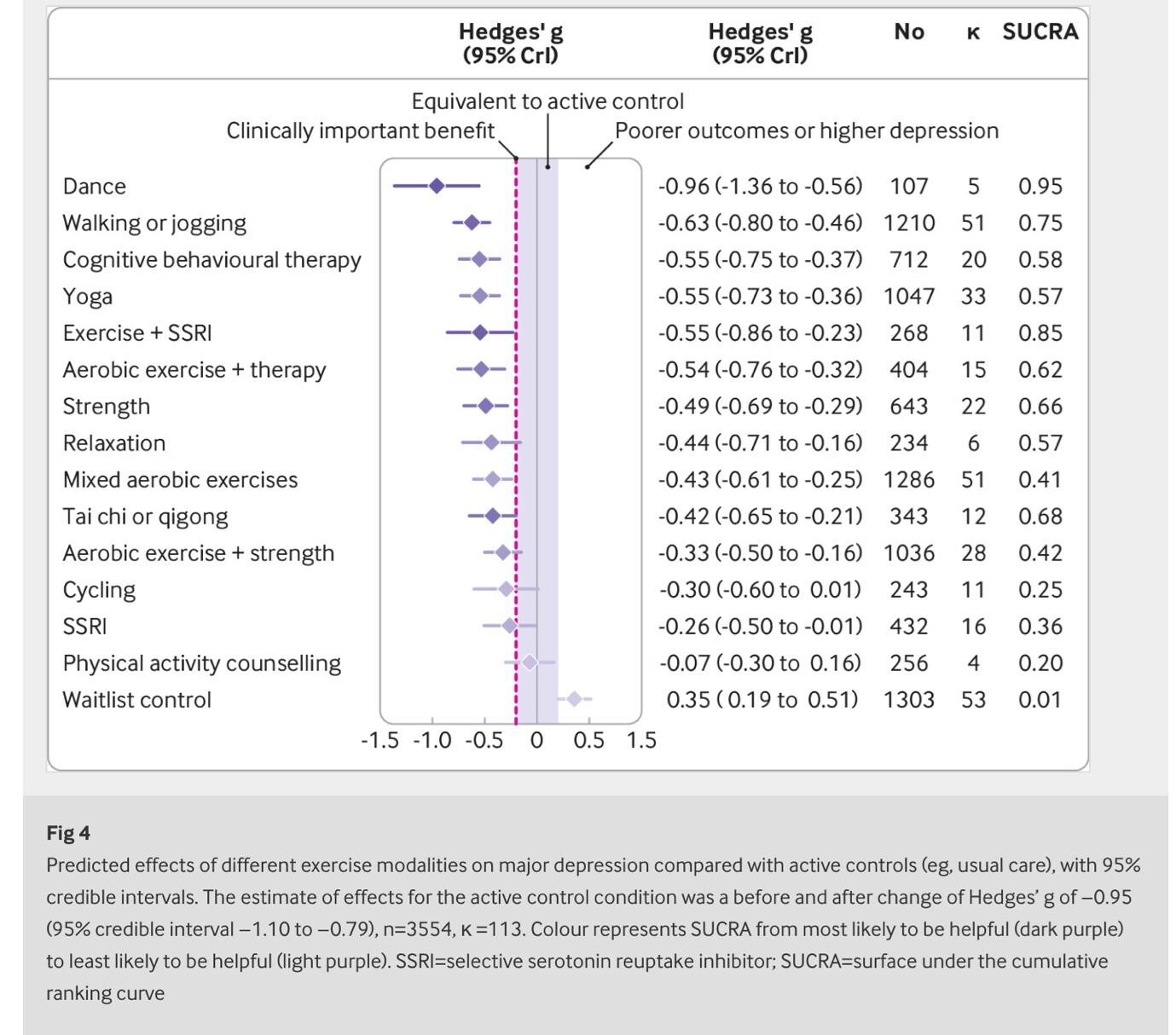 Source: Noetel et al., 2024
In the table above interventions with results further to the left of the pink dotted line are more effective. For comparison SSRI is standard drug treatment. The effectiveness of dance is interesting but not surprising.
Q5: What is the evidence that exercise reduces anxiety?
A systematic review in the Psychiatry research confirmed that exercise significantly reduces anxiety symptoms in patients with anxiety or stress-related disorders (Stubbs et al., 2017). The BMJ umbrella review of February 2024 further reinforced these findings, demonstrating that exercise is effective for anxiety as well as depression, with dance, yoga, and aerobic exercise showing particular benefit (Noetel et al., 2024). Moderate-intensity aerobic exercise appears most consistently beneficial, though the mechanisms, apply broadly across exercise modalities. From my clinical experience higher volume exercise with intermittent increasing intensity (such as hill walking or tennis) a social dynamic and especially exercise in nature is especially effective for mental well-being.
Q6: What is the evidence that exercise reduces the risk of dementia and neurodegenerative disease?
A prospective study of nearly 79,000 individuals found that higher daily step counts were associated with significantly lower dementia risk, with benefits of up to 25% observed from as few as 3,800 steps per day (del Pozo Cruz et al., 2022). Maximal benefit was shown around 10,000 steps. Exercise promotes neurogenesis, enhances cerebral blood flow, and may reduce amyloid-beta accumulation. In Parkinson's disease, high-intensity treadmill training has been shown to attenuate motor decline (Schenkman et al., 2018). AI-driven analysis of movement patterns captured by wearable sensors is also emerging as a promising tool for early detection of neurodegenerative conditions, potentially enabling earlier intervention.
Q7: What is the evidence that exercise reduces susceptibility to infections?
Regular moderate exercise enhances immune surveillance. A review by Nieman and Wentz (2019) found that consistent moderate activity reduces upper respiratory tract infections by 40–50% compared with sedentary behaviour, through improved circulation of immunoglobulins and natural killer cells. However, prolonged exhaustive exercise may transiently impair immune function, though recent evidence suggests this effect is less pronounced than once believed. Greater understanding of the physiology of recovery in addition to wearable technology and big data makes it more likely that going forwards we will be able to optimise the impact of exercise and stress reduction on immunity. As we learned that during Covid, there are two factors to infectious diseases. Exposure risk and Host response. We are all familiar with masks, quarantine and social distancing measures. Exercise works at the other side of the equation by boosting immunity.
Q8: What is the evidence that exercise improves physical capacity in old age?
Sarcopenia, the age-related loss of muscle mass and function, is among the most consequential yet underappreciated health challenges of ageing. Resistance training, even when commenced in the eighth or ninth decade of life, meaningfully increases muscle strength, improves balance, and reduces fall risk (Liu & Latham, 2009). At least one third of people over 65 years of age have a potentially significant fall in one year. Multicomponent exercise programmes reduce falls by 23% in older adults (Sherrington et al., 2019). Wearable accelerometers and AI-driven gait analysis are now being used to identify fall risk earlier and to tailor exercise interventions to individual deficits, a development with significant implications for preserving independence.
Q9: What is the evidence that exercise increases longevity?
A study of over 650,000 adults found that 150 minutes of moderate activity per week was associated with a gain of 3.4 years of life expectancy, rising to 4.5 years at 450 minutes per week, irrespective of body mass index (Moore et al., 2012). The Copenhagen City Heart Study provides further interesting data (Schnohr P, et al., 2013). This prospective study, which followed over 17,000 individuals for up to 35 years, found that regular jogging was associated with a reduction in all-cause mortality of approximately 44%, corresponding to an increase in life expectancy of 6.2 years in men and 5.6 years in women. The Copenhagen data also showed a particular benefit for racket sports (tennis extra 9.7 years, badminton extra 6.2 years) although in my opinion there are confounding factors around social determinants of health in this subset (Schnohr P, et al., 2018). Regardless, the Copenhagen findings reinforce a recurring theme: moderate, consistent exercise yields significant longevity gains.
Q10: Is there any evidence that too much exercise is bad?
Numerous studies demonstrate a clear correlation between high VO2 max (a measure of physical fitness) and a reduction in all-cause mortality. There have been questions as to whether too much exercise may be a problem. Most studies show a dose dependent impact with increasing benefit, albeit in reducing absolute terms, with increasing physical capacity. Again, the greatest benefit in proportional terms occurs when moving from very low capacity to moderate VO2 max.
It may be that too much exercise is bad for some people but this is very definitely the exception rather than the rule. There have been some associations between very high intensity exercise and cardiac arrythmia or cardiac fibrosis. There is also a risk of immune inhibition associated with over training. Some individuals with body dysmorphism may exercise as a compensatory mechanism and occasionally this can lead to harm. However, in my career, looking after a spectrum of individuals from Olympians and elite professional athletes, through to weekend warriors and those who prefer the sofa to the squash court, other than sports injury, I have seen only a handful of elite performance athletes who were over training to the extent of adversely impacting their health. Most people would be healthier if they did more, not less exercise.
Summary
The convergence of traditional epidemiology, clinical trials, wearable technology, and artificial intelligence is producing an evidence base of extraordinary depth and consistency. Exercise is not a panacea, but it is the closest approximation medicine has yet identified. The threshold for benefit is lower than most people assume, and the greatest gains, in percentage terms, accrue to those who move from doing nothing to doing something.
Finally, it is important to emphasise that exercise is much more than sport. Indeed it is essential not to put off the person who is not interested in sport. The most effective single intervention in the BMJ Depression intervention study was dance. For some people the best health intervention may be getting a dog. The prescription is simple. The evidence is beyond dispute. Stay engaged and do things with and for other people. Exercise in nature whenever possible. Define things in the positive not negative. Find what you love and do it. Move more than currently (for most people) and push yourself outside of your physical comfort zone sometimes.
References
- Morris, J.N., Heady, J.A., Raffle, P.A.B., Roberts, C.G. and Parks, J.W. (1953) 'Coronary heart-disease and physical activity of work', The Lancet, 262(6796), pp. 1111–1120. doi: 10.1016/S0140-6736(53)91495-0
- Banach, M., Lewek, J., Surma, S., Penson, P.E., Sahebkar, A., Martin, S.S., Bajraktari, G., Henein, M.Y., Reiner, Ž., Bielecka-Dąbrowa, A. and Bytyçi, I. (2023) 'The association between daily step count and all-cause and cardiovascular mortality: a meta-analysis', European Journal of Preventive Cardiology, 30(18), pp. 1975–1985. doi: 10.1093/eurjpc/zwad229
- Moore, S.C., Lee, I-M., Weiderpass, E., Campbell, P.T., Sampson, J.N., Kitahara, C.M., Keadle, S.K., Arem, H., Berrington de Gonzalez, A., Hartge, P., Adami, H-O., Blair, C.K., Borch, K.B., Boyd, E., Check, D.P., Fournier, A., Freedman, N.D., Gunter, M., Johannson, M., Khaw, K-T., Linet, M.S., Orsini, N., Park, Y., Riboli, E., Robien, K., Schairer, C., Sesso, H., Spriggs, M., Van Dusen, R., Wolk, A., Matthews, C.E. and Patel, A.V. (2016) 'Association of leisure-time physical activity with risk of 26 types of cancer in 1.44 million adults', JAMA Internal Medicine, 176(6), pp. 816–825. doi: 10.1001/jamainternmed.2016.1548
- Knowler, W.C., Barrett-Connor, E., Fowler, S.E., Hamman, R.F., Lachin, J.M., Walker, E.A. and Nathan, D.M. (on behalf of the Diabetes Prevention Program Research Group) (2002) 'Reduction in the incidence of type 2 diabetes with lifestyle intervention or metformin', New England Journal of Medicine, 346(6), pp. 393–403. doi: 10.1056/NEJMoa012512
- Colberg, S.R., Sigal, R.J., Yardley, J.E., Riddell, M.C., Dunstan, D.W., Dempsey, P.C., Horton, E.S., Castorino, K. and Tate, D.F. (2016). Physical activity/exercise and diabetes: a Position Statement of the American Diabetes Association. Diabetes Care, 39(11), pp.2065–2079. doi:https://doi.org/10.2337/dc16-1728.
- Pearce, M., Garcia, L., Abbas, A., Strain, T., Schuch, F.B., Golubic, R., Kelly, P., Khan, S., Utukuri, M., Laird, Y., Mok, A., Smith, A., Tainio, M., Brage, S. and Woodcock, J. (2022). Association between Physical Activity and Risk of Depression: a Systematic Review and Meta-analysis. JAMA Psychiatry, 79(6). doi:https://doi.org/10.1001/jamapsychiatry.2022.0609.
- Noetel, M., Sanders, T., Gallardo-Gómez, D., Taylor, P., del Pozo Cruz, B., van den Hoek, D., Smith, J.J., Mahoney, J., Spathis, J., Moresi, M., Pagano, R., Pagano, L., Vasconcellos, R., Arnott, H., Varley, B., Parker, P., Biddle, S. and Lonsdale, C. (2024) 'Effect of exercise for depression: systematic review and network meta-analysis of randomised controlled trials', BMJ, 384, e075847. doi: 10.1136/bmj-2023-075847
- Stubbs, B., Vancampfort, D., Rosenbaum, S., Firth, J., Cosco, T., Veronese, N., Salum, G.A. and Schuch, F.B. (2017). An examination of the anxiolytic effects of exercise for people with anxiety and stress-related disorders: A meta-analysis. Psychiatry Research, 249(0165-1781), pp.102–108. doi:https://doi.org/10.1016/j.psychres.2016.12.020.
- del Pozo Cruz, B., Ahmadi, M., Naismith, S.L. and Stamatakis, E. (2022). Association of Daily Step Count and Intensity With Incident Dementia in 78 430 Adults Living in the UK. JAMA Neurology, 79(10). doi:https://doi.org/10.1001/jamaneurol.2022.2672.
- Schenkman, M., Moore, C.G., Kohrt, W.M., Hall, D.A., Delitto, A., Comella, C.L., Josbeno, D.A., Christiansen, C.L., Berman, B.D., Kluger, B.M., Melanson, E.L., Jain, S., Robichaud, J.A., Poon, C. and Corcos, D.M. (2018). Effect of High-Intensity Treadmill Exercise on Motor Symptoms in Patients With De Novo Parkinson Disease: A Phase 2 Randomized Clinical Trial. JAMA Neurology, 75(2), pp.219–226. doi:https://doi.org/10.1001/jamaneurol.2017.3517.
- Nieman, D.C. and Wentz, L.M. (2019). The compelling link between physical activity and the body’s defense system. Journal of Sport and Health Science, 8(3), pp.201–217. doi:https://doi.org/10.1016/j.jshs.2018.09.009.
- Liu, C. and Latham, N.K. (2009) 'Progressive resistance strength training for improving physical function in older adults', Cochrane Database of Systematic Reviews, (3), CD002759. doi: 10.1002/14651858.CD002759.pub2
- Sherrington, C., Fairhall, N.J., Wallbank, G.K., Tiedemann, A., Michaleff, Z.A., Howard, K., Clemson, L., Hopewell, S. and Lamb, S.E. (2019) 'Exercise for preventing falls in older people living in the community', Cochrane Database of Systematic Reviews, 1(1), CD012424. doi: 10.1002/14651858.CD012424.pub2
- Moore, S.C., Patel, A.V., Matthews, C.E., Berrington de Gonzalez, A., Park, Y., Katki, H.A., Linet, M.S., Weiderpass, E., Visvanathan, K., Helzlsouer, K.J., Thun, M., Gapstur, S.M., Hartge, P. and Lee, I-Min. (2012). Leisure Time Physical Activity of Moderate to Vigorous Intensity and Mortality: A Large Pooled Cohort Analysis. PLoS Medicine, 9(11), p.e1001335. doi:https://doi.org/10.1371/journal.pmed.1001335.
- Schnohr P, Marott JL, Lange P, Jensen GB. Longevity in Male and Female Joggers: The Copenhagen City Heart Study. American Journal of Epidemiology. 2013;177(7):683-689. doi:https://doi.org/10.1093/aje/kws301
- Schnohr P, O’Keefe JH, Holtermann A, et al. Various Leisure-Time Physical Activities Associated With Widely Divergent Life Expectancies: The Copenhagen City Heart Study. Mayo Clinic Proceedings. 2018;93(12):1775-1785. doi:https://doi.org/10.1016/j.mayocp.2018.06.025