 Central General Practice
 Repulse Bay
 Clearwater Bay
 BodyWorX Clinic
 Central Specialist Clinic
 MindWorX Clinic
 Family Clinic
 OT&P Annerley Midwives Clinic
 WellWorX Clinic
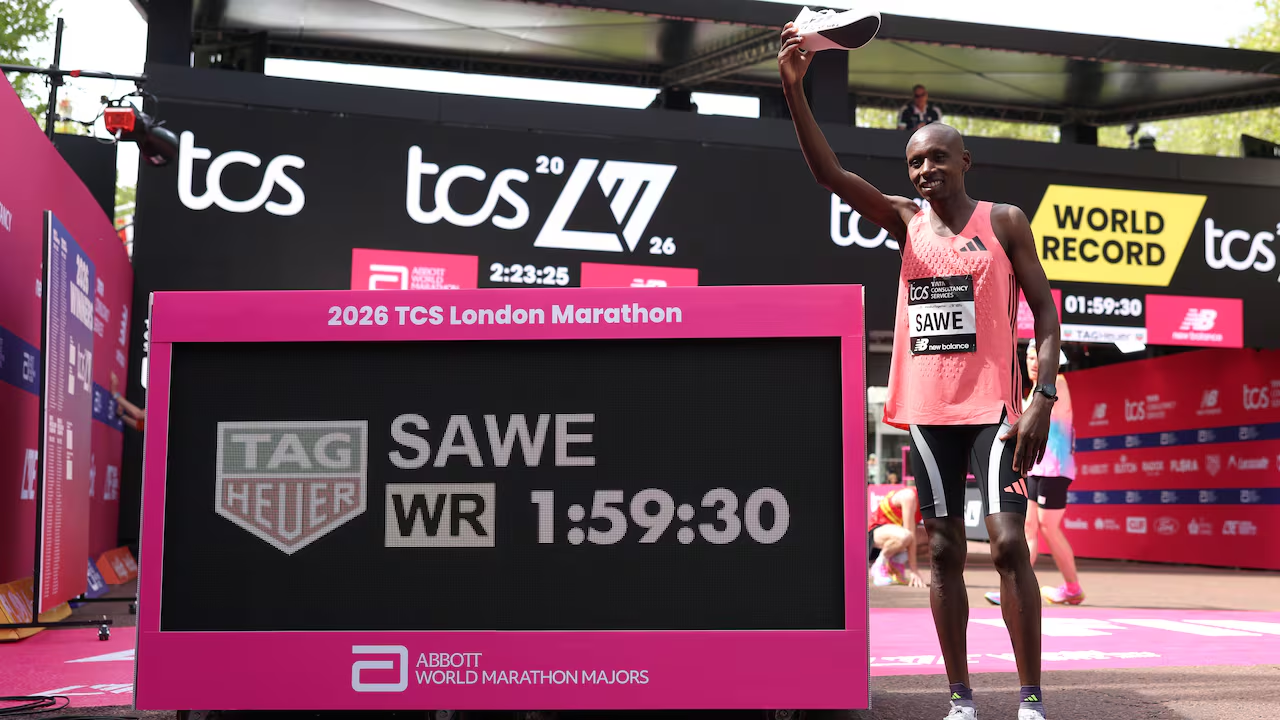
Twenty years ago I thought it was very unlikely that within my lifetime a marathon would be run in less than two hours. Last week in the London Marathon 2026 two athletes finished in under that time. London is not the ideal race for breaking records and there is a serious possibility that Berlin could be even faster. What changed and how can we explain such rapid improvements in performance?
The Historical Context
To understand the magnitude of this achievement, we must first examine the progression of marathon records. The first record eligible sub-2:10 marathon was achieved in 1967. It took another 36 years to break 2:05. The trajectory suggested diminishing returns—each incremental improvement requiring exponentially more effort and time. By the early 2000s, the consensus among exercise physiologists was that a sub-2-hour marathon, while theoretically possible, would require decades of marginal gains in training, nutrition, and athlete selection.
The maths seemed straightforward. A sub-2-hour marathon requires maintaining a pace of 2:50 per kilometer (4:34 per mile) for 42.195 kilometers. This demands sustaining approximately 21 kilometers per hour while operating at the threshold of human cardiovascular and metabolic capacity. The physiological requirements—VO2 max around 80 ml/kg/min, and lactate threshold around 90% of VO2 max—appeared to represent the outer limits of human adaptation.
Yet between 2018 and 2023, we witnessed an unprecedented acceleration in performance. In 2018, the world record stood at 2:02:57. By 2023, Kelvin Kiptum had lowered it to 2:00:35 in Chicago. This rapid improvement demands explanation beyond incremental training adaptations. To put this in perspective the world record for the 5k has improved by less than 2 seconds over the last 20 years.
The Shoe Revolution
The most visible and controversial factor has been the introduction of "super shoes”. The impact of footwear technology on marathon performance cannot be overstated.
Traditional running shoes were designed with cushioning and stability as primary objectives. The Vaporfly series introduced a radically different design philosophy: a thick midsole of energy-returning foam combined with a curved carbon fiber plate. Independent research published in Sports Medicine found that these shoes improve running economy by approximately 4%, translating to roughly 3 minutes over marathon distance for elite athletes.
The mechanism is two-fold. First, the curved carbon fiber plate acts as a lever, optimizing the biomechanics of the foot strike and toe-off phases. This reduces the energy lost to ground contact and improves propulsion efficiency. Second, the highly resilient foam returns energy that would otherwise dissipate as heat during impact.
The subsequent proliferation of carbon-plated shoes across manufacturers created a new baseline for elite competition. By 2023, every serious marathon contender was racing in some variant of super shoe technology. What was initially a competitive advantage became the standard, but the initial leap had permanently shifted the performance frontier.
World Athletics responded by regulating shoe specifications in 2020, limiting stack height (basically the sole thickness) to 40mm and the number of plates to one. This regulatory intervention prevented an arms race in footwear technology while preserving the gains already achieved. The argument was that while technology enhanced performance, the fundamental determinant remained human physiology and training. However, shoe technology continues to improve. The shoes worn by Sabastian Sawe in London weighed the same as six pairs of socks with a 50% reduction in foam weight. We do not know yet if these specific shoes provide an added benefit to prior iterations.
Training Science and Altitude
Parallel to the shoe revolution, advances in training methodology and altitude preparation have contributed to performance improvements. The Kenyan training model, which has produced a disproportionate share of elite marathoners, combines several elements that optimize physiological adaptation.
High-altitude training remains central. Athletes training at 2,400-2,500 meters elevation, experience hypoxic adaptation—increased red blood cell production, enhanced mitochondrial density, and improved oxygen utilization efficiency. However, the modern approach has become more sophisticated than simply "train high, compete low."
Contemporary training protocols often employ "live high, train low" strategies, where athletes sleep at altitude to gain blood benefits while conducting high-intensity workouts at lower elevations where oxygen availability supports maximum effort. Some athletes use altitude tents or hypoxic chambers to simulate elevation while remaining at sea level, though the efficacy of simulated versus genuine altitude remains debated.
The volume and intensity of training have also evolved. Elite marathoners now regularly exceed 200 kilometers per week during peak training blocks. The emphasis on race-pace work and threshold training has increased, moving beyond pure mileage accumulation to more targeted physiological stress.
Recovery science has similarly advanced. Elite athletes now have access to sophisticated monitoring—heart rate variability, blood lactate testing, continuous glucose monitoring—allowing for precise calibration of training load. Nutritional timing, sleep optimization, and recovery modalities (cryotherapy, compression, massage) are standardized components of professional training programs.
Fuelling Strategy: The Carbohydrate Revolution
Perhaps the least visible but equally critical factor has been the transformation in race fuelling strategy. The traditional guidance suggested consuming 60 grams of carbohydrate per hour during endurance events, based on the presumed maximum absorption rate of glucose transporters in the intestine.
Recent research has challenged this ceiling. Studies published in Medicine & Science in Sports & Exercise demonstrate that combining multiple carbohydrate sources—glucose and fructose—can increase absorption rates to 120 grams per hour or more.
By consuming 90-120 grams of carbohydrate per hour (360-480 kilocalories), athletes can significantly delay glycogen depletion and maintain glucose availability to working muscles and the central nervous system. Interestingly the extra carbohydrate is about much more than avoiding energy depletion to prevent "hitting the wall”. The extra glucose also appears to impact perceived exertion allowing higher intensity performance. One extraordinary finding is that even swilling concentrated sugar solutions in the mouth and spitting them out has been shown to improve performance. Some studies have estimated that increasing carbohydrate from 60 grams per hour to 120 grams per hour may have a performance benefit similar to that of shoe technology. Sabastian Sawe consumed an average of 115 grams per hour in London. A quantity that had been specifically identified as optimal for him based on trials during his training.
The practical implementation of such high carbohydrate intake involves consuming gels, sports drinks, or specialized nutrition products regularly throughout the race.
Crucially, high carbohydrate intake during racing requires "training the gut." Athletes must practice consuming large quantities of carbohydrate during training to upregulate transporter expression and reduce gastrointestinal distress. Elite marathoners now incorporate race-pace runs with aggressive fuelling protocols specifically to adapt their digestive systems.
The shift has been dramatic. In the early 2000s, elite marathoners might consume 30-40 grams of carbohydrate per hour. Current protocols have doubled or tripled that intake. The use of high dose carbohydrate in addition to bicarbonate has undoubtedly led to a measurable performance benefit. Possibly as much as 2 minutes over a marathon distance.
Pacing and Tactical Evolution
The optimization of pacing strategy represents another incremental but meaningful factor. Historically, marathons were often run with conservative first halves and faster second halves (negative splits). While physiologically efficient, this approach had the potential to leave time on the table.
One of the problems of distance running is to avoid going too hard. Pushing past physiological thresholds creates what is known as an oxygen debt. This takes time for recovery and ultimately leads to slower times. Elite athletes must be functioning close to their physiological threshold at all times. Understanding the concept of pacing and individualising this process through training has led to significant performance gains. Training, in addition to real-time pace feedback via GPS watches, allows athletes to execute these strategies with unprecedented precision.
In the London Marathon Sebastion Sawe ran the first half in 1 hour 29 seconds and the second half in 59 minutes 1 second. His 5K times got faster after 30km and he finished the last 2km faster than at any other section. It is incredible to think that the second half of the London marathon was one of the fastest half marathons ever run.
Athlete Selection and Depth
Finally, we must acknowledge the role of athlete selection and the depth of competition. The concentration of East African dominance in distance running reflects both genetic predisposition (favorable muscle fiber composition, body proportions, oxygen utilization efficiency) and cultural factors (running as economic opportunity, established training infrastructure, high-altitude environment).
The competitive depth in marathon running has increased substantially. In 2000, approximately 10 athletes ran sub-2:07. In 2023, over 50 athletes achieved this standard. This deepening of the talent pool creates more competitive races, pushes standards higher, and increases the probability that exceptional individuals will emerge and converge with optimal conditions.
Conclusion
The breakthrough of the 2-hour marathon barrier results from the confluence of multiple factors. The result of advances in technology in addition to greater scientific understanding, especially in shoe technology, the science of fuelling and a more scientific approach to training and pacing has recalibrated the expected times for elite marathon races such that it is very hard to compare the achievement in London with historical times which were run without such benefit.
One lesson, perhaps, is that predictions of performance ceilings must account for technological and methodological innovations that can shift the landscape rapidly.
The question now is not whether sub-2-hour marathons are possible, but how common they will become. Was the London race a freak occurrence, akin to Bob Beamon’s long jump in the Mexico Olympics in 1968 or is sub 2 hours the new normal? My money would now be on the latter, indeed Berlin 2026 may see even faster times. The frontier has moved, and the next generation of athletes will build from this new baseline, equipped with shoes, science, and strategies that continue to evolve.
The 2-hour marathon is no longer impossible. It is the new standard we measure ourselves against.
If you are considering starting or changing an exercise programme, particularly if you have pre-existing medical conditions or are over 40, a health screening is a sensible first step. Our general practice and physiotherapy teams at OT&P are available to provide evidence-based advice tailored to your individual circumstances.
References
- Barnes, K.R. and Kilding, A.E. (2019) 'A randomized crossover study investigating the running economy of highly-trained male and female distance runners in marathon racing shoes versus track spikes', Sports Medicine, 49, pp. 331–342. https://doi.org/10.1007/s40279-018-1012-3
- Muniz-Pardos, B., Sutehall, S., Angeloudis, K., Guppy, F.M., Bosch, A. and Pitsiladis, Y. (2021) 'Recent improvements in marathon run times are likely technological, not physiological', Sports Medicine, 51, pp. 371–378. https://doi.org/10.1007/s40279-020-01420-7
- Joyner MJ, Coyle EF. Endurance exercise performance: the physiology of champions. J Physiol. 2008;586(1):35-44. https://doi.org/10.1113/jphysiol.2007.143834
- Jones, A.M. (2006) 'The physiology of the world record holder for the women's marathon', International Journal of Sports Science and Coaching, 1(2), pp. 101–116.
- World Athletics (2026) Marathon - men - senior - all time top lists. Available at: https://worldathletics.org/records/all-time-toplists/road-running/marathon/all/men/senior (Accessed: 30 April 2026).
- World Athletics. Technical Rules, Rule 5.13. World Athletics Book of Rules. 2020 (amended 2022). Available at: https://www.worldathletics.org/download/download?filename=29eea293-b5c1-42a4-9838-bdeaa31d2e48.pdf&urlslug=C2.1%20-%20Technical%20Rules%20 (Accessed: 30 April 2026).
- Nigg, B.M., Cigoja, S. and Nigg, S.R. (2020) 'Teeter-totter effect: a new mechanism to understand shoe-related improvements in long-distance running', British Journal of Sports Medicine. https://doi.org/10.1136/bjsports-2020-102550
- Podlogar, T., Bokal, Š., Cirnski, S. and Wallis, G.A. (2022) 'Increased exogenous but unaltered endogenous carbohydrate oxidation with combined fructose-maltodextrin ingested at 120 g h⁻¹ versus 90 g h⁻¹ at different ratios', European Journal of Applied Physiology, 122, pp. 2393–2401. https://doi.org/10.1007/s00421-022-05019-w
- Wilber, R.L. and Pitsiladis, Y.P. (2012) 'Kenyan and Ethiopian distance runners: what makes them so good?', International Journal of Sports Physiology and Performance, 7(2), pp. 92–102. https://doi.org/10.1123/ijspp.7.2.92
- Levine BD, Stray-Gundersen J. "Living high-training low": effect of moderate-altitude acclimatization with low-altitude training on performance. J Appl Physiol. 1997;83(1):102-112. https://doi.org/10.1152/jappl.1997.83.1.102
- Utter, A.C., Kang, J., Nieman, D.C., Dumke, C.L., McAnulty, S.R., Vinci, D.M. and McAnulty, L.S. (2004) 'Carbohydrate supplementation and perceived exertion during prolonged running', Medicine and Science in Sports and Exercise, 36(6), pp. 1036–1041. https://doi.org/10.1249/01.mss.0000128164.19223.d9


-2.png?length=500&name=%5BMKT%5DWebsite%20Blog%20Photo%20(23)-2.png)
.png?length=500&name=%5BMKT%5DWebsite%20Blog%20Photo%20(22).png)